
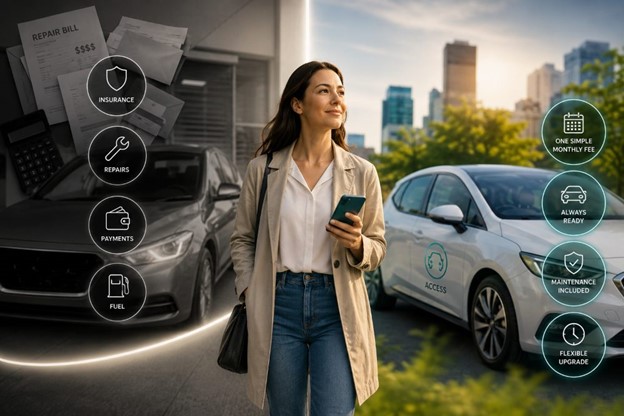
You Subscribe to Everything Else in Your Life. Why Not Your Transportation?
Take a look at your monthly expenses and something interesting jumps out. Music on demand. Your favorite streaming shows. Cloud storage for your photos. The software that runs your business. Even your gym. Almost everything that matters in daily life now runs on a subscription model. You pay for access, you get the experience you need, and you move on with your day. No enormous upfront costs. No commitment to hardware that becomes outdated in three years. Just reliable, ongoing access to something genuinely useful. It is such a normal way to live that most people never stop to notice it.
So Why Is the Car Still the Exception?
Somehow the car stayed stuck in the old model. You either buy one, lease one with all sorts of conditions attached, or rely on ride apps that charge surge pricing at the exact moments you need them most. None of those options are particularly great. Buying locks up a serious chunk of your financial life. Leasing comes with mileage caps and end-of-term fees that catch people off guard. Ride apps are fine for occasional use but brutal on the wallet if you depend on them daily. The surprise is that it took this long for transportation to catch up with every other category of life that already made the subscription shift.
What a Subscription Model Actually Gives You
A subscription-based transportation service flips the entire dynamic. Instead of a large purchase price and a decade of ongoing costs, you pay a predictable monthly amount for access to a vehicle that is maintained, updated, and ready when you need it. No surprise repair bills. No insurance renewal negotiation. No trying to sell a depreciated car a few years down the road and wondering how much you lost in the process. Just clean, reliable access to modern transportation baked right into your regular monthly budget. The same way you think about your phone plan or your cloud storage. It is transportation that finally fits the way modern people actually manage their money.
Rethinking What Ownership Even Means
There is a deeper shift happening here too. Ownership used to be how you demonstrated stability. A house. A car. Physical things you could point to as proof that you were doing alright. But that definition is getting replaced by something else entirely. Access and flexibility are starting to feel more valuable than possession. Especially when possession comes with so much overhead. A car sharing alternative to ownership is not a compromise for people who cannot afford to buy. It is an intentional choice by people who have done the math and decided their money works harder somewhere else. That reframe matters, because it changes who this conversation is actually for.
The Financial Logic Is Pretty Simple
When you stop owning a car, a meaningful amount of money stops leaving your life every month. The insurance payment goes away. The loan payment goes away. The random repair that shows up twice a year goes away. What replaces all of that is one predictable number you actually planned for. People who make this shift often describe it as one of the clearest financial decisions they ever made. Not because they gave something up, but because they realized they were paying for something they did not actually need in the form they were paying for it. That clarity alone is worth quite a bit.


Leave a Reply